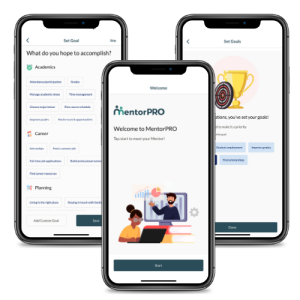
MentorHub has joined social media!
By Megyn Jasman, MentorHub MentorHub, the supportive accountability app and web platform for mentoring relationships, has joined Instagram and Twitter! Learn about all things MentorHub @mentorhubapp

By Megyn Jasman, MentorHub MentorHub, the supportive accountability app and web platform for mentoring relationships, has joined Instagram and Twitter! Learn about all things MentorHub @mentorhubapp

Thomas P. Le,Ti Hsu,Elizabeth B. Raposa (2021). Effects of natural mentoring relationships on college students’ metnal health: The role of emotion regulation. American Journal of Community Psychology. Abstract (from article) The transition to college involves a number of novel stressors for young adults and represents a period of heightened risk for the onset or worsening […]

Having a professor, adviser or other mentor can greatly help in navigating college and launching a career, but many students aren’t seeking out such relationships. By Melissa Ezarik, Reprinted from Inside Higher Ed In a recent check-in with a University of Kentucky doctoral student, associate professor Melinda Ickes detected an all-too-common issue: overinvolvement. “She was […]

Proactive student support and mentorship culture is undervalued in academia, writes Becca Spindel Bassett, who studies inequity in higher ed. By Becca Spindel Bassett, Reprinted from Inside Higher Ed Colleges are more than departments, buildings, and classes. They are organizations composed of resources and relationships. Supportive campus relationships yield resources so valuable that we shouldn’t […]

Monjaras-Gaytan, L. Y., Sánchez, B., Salusky, I., & Schwartz, S. E. O. (2021). Historically underrepresented college students and institutional natural mentors: An ecological analysis of the development of these relationships at predominantly White institutions. Journal of Community Psychology. https://doi.org/10.1002/jcop.22682 Summarized by Ariel Ervin Notes of Interest: Although college is an opportunity for the upward mobility of underrepresented youths, […]

By Julia Freeland Fisher, Christensen Institute Last spring, I had the chance to speak with Jean Rhodes, a leading researcher in the world of mentoring, and author of the book Older and Wiser: New Ideas for Youth Mentoring in the 21st Century. For schools managing yet another year of pandemic upheavals, Rhodes’ findings offer a […]

McClain, C. M., Kelner, W. C., & Elledge, L. C. (2021). Youth Mentoring Relationships and College Social and Academic Functioning: The Role of Mentoring Relationship Quality, Duration, and Type. American Journal of Community Psychology. https://doi.org/10.1002/ajcp.12539 Summarized by Ariel Ervin Notes of Interest: Youth mentoring relationships are known for improving social, academic, psychological, and behavioral outcomes for children […]

Hart, M. J., Flitner, A. M., Kornbluh, M. E., Thompson, D. C., Davis, A. L., Lanza-Gregory, J., McQuillin, S. D., Gonzalez, J. E., & Strait, G. G. (2021). Combining MTSS and Community-Based Mentoring Programs. School Psychology Review. Summarized by Ariel Ervin https://doi.org/10.1080/2372966X.2021.1922937 Notes of Interest: Although American schools offer mental health services for youths, they are limited […]

By Gene Beresin and Khadijah Booth Watkins, Reprinted from The Clay Center for Young Healthy Minds Currently, around half of all students attending college are the first in their families to do so. First-generation (first-gen) students have many strengths, as shown in the research. They tend to have higher satisfaction in college compared with non-first-gen […]


MentorPRO is a leading digital tool platform to support educators to build developmental relationships with their students in easy and fun ways.

In support of our continued conversation on how to support today’s youth, this issue of the Chronicle of Evidence-Based Mentoring is proudly sponsored by Along, a free digital tool designed to support educators to build developmental relationships with their students in easy and fun ways.

MENTOR: The National Mentoring Partnership (MENTOR) is the unifying champion for expanding quality youth mentoring relationships in the United States. For nearly 25 years, MENTOR has served the mentoring field by providing a public voice, developing and delivering resources to mentoring programs nationwide and promoting quality for mentoring through standards, cutting-edge research and state of the art tools.

Academic Web Pages is the leading provider of customized websites for researchers, centers, nonprofits, and universities. AWP designed and has contributed generously to the creation of the Chronicle of Evidence-Based Mentoring.