What Two New Reports and a Podcast Reveal About AI in Mentoring
By Jean Rhodes
“If we had sufficient funding and staff, we would not need to utilize AI,” a mentoring professional explained in MENTOR’s new report, Human Connection in an AI World. “It has simply become a time saver for the backend work of a small nonprofit” (Tanyu et al., 2026, p. 17). Much of the discussion about AI in mentoring concerns the prospect of chatbots replacing caring adults. In the programs represented in this report, staff were more often turning to AI for help getting through their workday. They described using it to write grants, summarize meetings, translate materials, and make sense of program data.
Researchers Manolya Tanyu, Michael Garringer, and Rachel Bennett drew on a survey of 249 mentoring professionals, interviews with 7 program leaders, and a listening session with 12 stakeholders. Among survey respondents, 60% were using AI at least occasionally in their work. Of the 169 respondents who reported formal or informal AI use within their organizations, 84% indicated that it was being used for writing and content development, compared to just 8% for direct youth engagement. Although this was a voluntary sample, the findings provide a useful account of how staff are incorporating AI into the day-to-day work of running a mentoring program (Tanyu et al., 2026).
The appeal is understandable, particularly for smaller programs where the same person may be responsible for supporting matches, communicating with families, and preparing the next grant application. One program leader likened AI to putting staff on an electric bike so they wouldn’t have to pedal quite so hard. Others described being able to spend more time with the people they served (Tanyu et al., 2026). These are reasonable uses of technology. But the assumption that time saved on administrative work will translate into better mentoring deserves the same scrutiny we would give any other proposed program improvement. We need to know what staff are able to do with that time and whether mentees benefit.
In the meantime, staff are often figuring this out on their own. Among respondents who used AI at least occasionally, 76% reported that their organizations had no formal AI policies or procedures. One participant described uncertainty about whether using AI would even be viewed favorably by their employer (Tanyu et al., 2026).
How do Mentees Feel About AI?
There is also the question of how mentees themselves feel about AI. In our new study in Translational Issues in Psychological Science, Werntz, Hersch, Lamont, and Rhode (in press), we asked 65 undergraduates at a public minority-serving institution to consider peer mentoring with and without AI assistance. In the AI-assisted description, mentors could copy and personalize suggested answers to students’ questions. A human mentor would still be responsible for responding. Nevertheless, students rated mentoring without AI as more useful and were more confident recommending it to a friend (Werntz et al., in press). Students were also more comfortable with AI drawing on academic information than personal information and, on average, students were neutral about whether AI would help mentors provide better answers. Their open-ended responses ranged from positive to negative, with many expressing mixed feelings about its use (Werntz et al., in press).
Some students saw practical benefits, describing AI as useful for finding resources, gathering information, and helping with organization. In their recommendations, they often assigned the work of building relationships and providing personalized guidance to the mentor, with AI serving a supplementary role.
Human-at-the-Helm
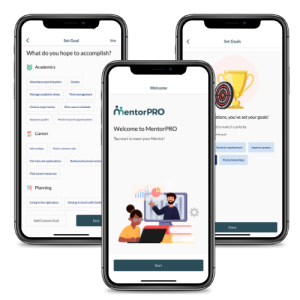
I recently discussed these issues with Mollie Ames on LearningWell Radio in the episode Mentorship Meets AI with Jean Rhodes. We talk about how mentoring contributes to students’ development and access to people who can help them, and what might be lost when that support is delegated to a chatbot. I describe our human-at-the-helm approach and how our MentorAI (the mentor-facing component of MentorPRO), which does not ommunicate directly with mentees. Instead, the mentor can use this support to prepare for a conversation, consider an unfamiliar problem, or identify a useful referral.
Taken together, these reports makes clear that mentors and staff need guidance and support, but that we need to consider if and how access to AI affects the authentic relationship that lies at the core of effective mentoring.
References
Ames, M. (Host). (2026, October 27). Mentorship meets AI with Jean Rhodes, University of Massachusetts Boston (No. 37) [Audio podcast episode]. In LearningWell Radio. LearningWell Magazine. https://learningwellmag.org/article/mentorship-meets-ai-with-jean-rhodes
Tanyu, M., Garringer, M., & Bennett, R. (2026). Human connection in an AI world: The opportunities and challenges of using AI in delivering youth mentoring services. MENTOR. https://mentoring.org/wp-content/uploads/2026/10/Human-Connection-in-an-AI-World.pdf
Werntz, A., Hersch, E., Lamont, M., & Rhodes, J. (in press). Understanding undergraduates’ attitudes toward AI-assisted peer mentoring: Balancing authenticity with efficiency. Translational Issues in Psychological Science.
Publication note
The research findings were checked against the supplied documents, and the podcast summary was checked against the episode audio. The MENTOR publication is a field report rather than a peer-reviewed journal article. The Werntz article’s journal and in-press status follow the author’s confirmation. Its DOI or publication URL could not be confirmed. The MentorAI description concerns its design and intended use, not demonstrated outcomes from the attitudes study.