Mentorship Meets AI with Jean Rhodes
A conversation with Mollie Ames
Adapted from LearningWell Radio for the Chronicle of Evidence-Based Mentoring. This interview has been lightly edited for clarity and readability. The radio introduction, closing credits, fillers, and repeated starts have been omitted.
MA is Mollie Ames. JR is Jean Rhodes.
MA I wanted to start with some foundational definitions. Is there a single definition that you look to to describe mentoring? How does it get confused with advising? Where do you draw the line around what mentorship entails?
JR You started with one of the hardest questions in the field. We really are pretty promiscuous with the word mentoring. It can range from your beloved second-grade teacher to somebody you meet through a mentoring program and have a more short-term relationship with, to an advisor.
One of the key distinctions people make is whether it is a formal mentoring relationship. That means, was it assigned, and is there a program structure around it? Then there are what are called natural or informal mentoring relationships.
There really isn’t one good definition, but there are things that qualify. One is that it’s more than just the transfer of information. It usually involves a connection that can lead, particularly for young people, to some really positive developmental outcomes. It can promote their social-emotional development, their identity development, their career development, and even their cognitive development if it’s done right. When it’s set up properly, whether it’s formal or informal, it can have these really profound effects. So it’s more than just a passing relationship.
MA Not to completely oversimplify it, but maybe it’s something you know is happening when you’re in it.
JR Exactly. Or even retrospectively, you can look back and realize that some people were core mentors in your life.
MA It’s interesting to think about knowing a mentorship happened based on how it impacted you. When you first got into this work, was there an element that really struck you about why mentorship is so important, especially in the college setting?
JR I’m going to tell my personal story now. I grew up in New Jersey, and right as I was going off to college, my father got caught up with some elements of New Jersey crime and had to enter the Federal Witness Protection Program. I allude to this in my book. My parents got divorced after 30 years, and I was going off to college with this huge question. Who am I? Everything that I knew was shifting.
I got to college not really knowing who I was. I was kind of a mediocre student, a Jersey girl, and my best friend who I met there, Marina Albee, her dad really just took an interest in me. He saw something that I hadn’t even seen myself. I took courses with him, and he had such a profound influence on me. At that point in time, I didn’t even know you could be a doctor if you weren’t a medical doctor. He opened up the whole idea that you could study things and get expertise.
He was a clinical psychologist. He had previously been the president of the American Psychological Association and the founder of a whole field called community clinical psychology, and he shepherded me into that field. I went from having a diffuse identity to, within a few years, pursuing a PhD in clinical psychology.
When I got to graduate school, it was such a profound relationship that had shaped me so importantly that I started looking around to see whether there was really a field around this idea of a nonparent adult. And there wasn’t. I have been like a compulsive gold miner, chipping away at this field ever since, every day discovering new ways of thinking about mentoring and really trying to establish an academic field of mentoring.
MA So you were the original data point in your research in mentoring?
JR Yeah. I was an assistant professor right out of grad school at the University of Illinois, and this was before there was even the internet. I had these really core questions about mentoring. One of them was, is this kind of thing that I had with George Albee the thing that you can replicate through a program? Are those 2 things apples and oranges? And if so, how best to do that?
I also wanted to know, is it a proxy indicator of resilience, or is it causing the resilience? Was I going to make it anyway, and he was drawn to me because I had some kind of spark, or was it because of him that I had this spark?
At the time, psychoanalytic theory was very big, and attachment theory. What about people who don’t have strong attachments with their own parents? Do you have to have that in order to trust another adult, or is it a corrective experience? That is, you can reformulate how you think about attachment.
MA The student also, I would imagine, needs to be really bought into the mentorship. If you as the young person aren’t also willing to put in the time in an unstructured way, then it won’t happen.
JR Absolutely. I think it is useful to think about what’s happening when a person is making that transition to college. For most people, it coincides with the transition to early adulthood, and that is one of the most consequential transitions of our lifetime.
We go from having our parents as the authority, or stepparents, and having these vertical relationships to really focusing more on what we might call horizontal relationships. We start to substitute parental authority for our own authority. We start to connect with peers and romantic relationships, and so we’re having this social-emotional transformation.
We’re also having a cognitive transformation. We become much more critical thinkers if we have the right scaffolding. We become much more hypothetical, and we’re able to do things that we couldn’t do. We go from what Piaget called concrete thinking to more formal operational thinking, which is a little bit more complicated.
We’re also really trying to figure out who we are. Right as we’re going to college, you have to pick a major. What kind of friendship group do I want? Who do I want to be? All of that is happening during this transition to college. Caring adults can be really important to that process as we shift away from our own parents.
MA You mentioned that from the start you were trying to build this field around mentorship, I would say successfully. At what point did AI come into the conversation or enter your field in a major way?
JR I was primed for it, and I’ll tell you why. Community psychology is the idea that we will never bridge gaps in mental health or any other thing by treating people one-on-one, treating the casualties. We have to move upstream. We have to look for ways to scale support.
One of the ways you do that is with paraprofessionals, people who don’t have a PhD or an MD in psychiatry. How do you do that? That’s what really drew me to mentoring as a field. If we could take this volunteer workforce and really make them great, we can scale mental health care, we can scale coaching, all sorts of things that young people need.
That’s where I was when I was writing a book for Harvard University Press right before the pandemic. I actually finished it during the pandemic. Technology has a really important role to play in scaling paraprofessional, volunteer mentor support.
At the time, and even now, there is this whole emerging field of digital mental health interventions. You hear about them, like Calm and Headspace, but other ones as well, Healthy Minds intervention. They were showing effects. One of the solutions I had to scaling effective mentoring was, why don’t we get mentors and mentees to use these digital tools together? Then the mentor can provide what’s called supportive accountability, keeping the person using that effective digital tool.
In a lot of the book, I talk about something called blended mentoring. It was really beginning to say, there are all these great tools. Maybe you have a student who’s having trouble making friends because they’re newcomers and they don’t speak English as well as their friends. You could do a digital intervention with them. The mentor could. Or maybe it’s something about anger management. There’s probably a digital intervention around that, and we could practice that together.
It was a way to scale really good evidence. That’s where the book ended. This is a really big frontier. We need to be harnessing technology to scale good support.
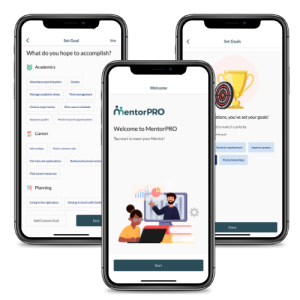
That led me to create a platform. At first it was called Supportive Accountability Hub, which is a mouthful. I got better at positioning it, but the idea was, we’ll do API integrations with all the best tools, and the mentor and the mentee will figure out what they want to work on, and then they’ll download the best possible tool for that. That was the beginning of MentorPRO, which is what I built AI into.
MA The million-dollar question is, how are those original apps, Calm and Headspace, different from AI tools in the way they should or could be implemented? How have you approached that?
JR We tried valiantly to get young people to use these tools, and it’s very hard, because young people open their phone and they want to quickly do other things, go to TikTok or whatever. I still haven’t given up on this idea.
AI and the entrance of chatbots is so different. It’s not an offshoot. It’s not like an activity that the mentor and mentee do together. It risks actually substituting the mentor, and that’s what we’re seeing more and more of. You lose the core of mentoring, which is the relationship, when you substitute the relationship for a chatbot.
MA What are some of the chatbot risks with mentoring? You mentioned the transition that college students are going through and some of the developmental progress they hope to make when they go into college.
JR I think there are a number of risks that we need to think about. Chatbots are becoming ubiquitous on college campuses, and there is evidence that they are replacing meetings with advisors. About half of students are saying they’re skipping their meetings with their advisors because they can get their answers more quickly. As if our role was purely just to answer questions.
I’ll start with the fact that these chatbots are trained on Western datasets and instantiate a lot of the biases and stereotypes of their training data. The colleges say they’re only using it because we can’t offer 24/7 support, and somebody might need to know how to drop a class in the middle of the night. But the evidence is very clear that an initial administrative use of it very quickly morphs into using it as a companion and as a substitute for relationships.
There’s even research that shows that people turn to chatbots when they’re lonely, and that prevents them from taking the risk of entering imperfect relationships that are full of friction. It also can sometimes give answers that are incorrect, and that can be consequential if it’s deadlines and things like that, although they’re getting better at that.
The companies will tell you, don’t worry about any of those things because we have a human in the loop. You’ve probably heard that term. The more I read about that, the more I realized that that was really just performative. There is no way that humans can keep up with the pace of algorithmic output. In this very moment, probably millions of things have gone directly from a chatbot to a student on our college campuses. It’s mostly retrospective. It’s between 5 and 15% that ever even get looked at. It’s really the Wild West, I think, of things going to students.
There’s also the question of when a student asks a question, there’s more to it than just getting the answer. A student might go to a chatbot and say, how do I transfer to another campus?
This past May, a student came to me instead. I’m an advisor to many students at UMass Boston, which is the third most diverse university in the United States. There are a lot of first-generation students, a lot of commuter students, and students who are marginalized. Instead of going to the chatbot, mercifully, she reached out to me, and she said, how do I transfer?
You can picture the answer a chatbot would give. Oh, good idea. I asked the question behind the question. Why? Why do you want to leave? She knows me. I just kept asking. “I don’t feel like I fit in.” But why? Are there things you could do here that would satisfy that? You already have some momentum here.
After about 3 or 4 of these back-and-forths, she revealed that she had just lost a parent and was completely in crisis. It was clear that this sense of not belonging was so multidetermined. It wasn’t just the campus, and changing the campus wasn’t going to solve that.
Instead, we connected this student with a professor from several semesters back who was being really supportive and had driven out to her house, 40 minutes outside of Boston. A chatbot just doesn’t have that capacity to say, I’ve been through things like this. I lost a parent, and you get over it. Things that make us real people. The empathy, the ability to share similar experiences of getting over things. Even our mistakes, our faults. All the friction of relationships gets lost when students substitute speaking to faculty and staff and advisors and mentors with AI.
MA You mentioned human in the loop as having an oversight role as a person to what the AI chatbots or whatever the tool might be is doing. I know your preferred approach is human at the helm. Can you tell us a little more about it and what it’s looking like at UMass these days?
JR The other insight I had before I get to human at the helm was that even if human in the loop could solve all of this, get really accurate information and put guardrails around it and have more humans, it doesn’t solve a core function of higher ed in the future. Higher ed is filled with people with a lot of social capital. There are professors, there’s staff, there’s alumni.
That is going to become more and more consequential as the traditional markers of what it means to go to college go away. With AI solving our problem sets, having our students turn in the right papers, what’s going to matter for college, what’s going to be the biggest value proposition for colleges, is going to be, do you have someone who can vouch for you? Do you have social capital? Do you have connections to the alumni here so that you can get the jobs that aren’t going to be just filtered out by AI screeners at the employment end?
We have lots of research to show that those relationships are just as important as whatever students learn in college. Coming from that framework, as a clinician, as a parent, as somebody who had benefited from mentoring, but also somebody who saw the value of social capital for students at UMass, I was opposed to the idea of this substitution, what Sherry Turkle is now calling artificial intimacy. These chatbots are really good at performing empathy, but they can never feel it.
I had already developed a platform called MentorPRO, where the whole idea was to make mentors more evidence-based, give them the training they need, track the relationships, provide supervision, all of those things. I thought, how do we bring AI into this platform in a way that doesn’t replace the human connection, but actually has a chance at improving and scaling the human connection?
I worked with my sister, who’s my co-founder, and other very smart people, as well as engineers. What we came up with was this idea of all the information that MentorPRO is collecting, as well as all the other information that a campus collects, like Canvas and Salesforce. What if that could all be harnessed by AI to do the back-office part of what it means to be a good advisor? Prepare me for the meeting. Look over the notes from our last conversation.
Even with this student, if I had gone in and I knew exactly where she was in her sequence at UMass, what her major was, all the things I had to look up, if it could just do that in an instant, it would free up 15 to 20 minutes.
The other piece is, what if it could also in that moment provide just-in-time training? Say I’m working with somebody and they’re starting to talk about having trouble sleeping or having trouble finding a job. The AI could surface an evidence-based tool. It brings me back to that supportive accountability first model. Here’s something that might be useful for you. I didn’t have to spend 15 minutes fumbling around doing literature reviews, because I’ve already trained the human-at-the-helm model, which we call MentorAI, with best-in-class, peer-reviewed journal articles on workforce development, on mental health, on student success, on mentoring.
The idea is that you would train it to be really evidence-based around student success, provide these instant snapshots, and enable the mentor to go back and forth even within a chat conversation to get that expert advice they need to be more effective. That’s going back to this idea of community psychology, of scaling paraprofessional support with the best possible tools.
MA Did you mention that this is currently being done on a large scale at UMass? Going back to the beginning, I imagine that’s in a structured manner, in terms of an established mentorship relationship. Or is it open to professors if a student comes into your office and you have a mentor-like relationship with them?
JR I feel very strongly that if we’re going to put technology out there in the world, if we’re innovators and we’re grappling with these things, we shouldn’t just do what a lot of companies do, which is put out white papers and say, this works, 72%, and these stats are just made up.
I really want to know, does having this tool diminish the mentoring relationship or does it help it? If it’s a no, then how can we make it better? It’s an evolution. It’s a scientific pursuit.
What I was able to do with funding from Axim Collaborative as well as the National Science Foundation is a 4-campus randomized control trial of this approach. Across all of these campuses, incoming students get a peer mentor who is well trained and is using our platform. The first year it’s just going to be transfer students. The second year it’s all incoming students.
Half of them don’t even get a mentor, don’t get to use our platform. So we get to test whether this platform actually works. Within that, we’re doing A/B testing of this human-at-the-helm approach to see whether and how AI can improve and not diminish human connection. Students do have concerns about the entry of AI into this precious relationship. How do you do it right? That’s what we’re trying to get at.
MA How far along are you in this process? Are there any findings to report at this point?
JR I have findings to report about the platform itself. This is using propensity score matching, so it’s not a randomized control trial, but it’s associated with a stronger sense of belonging, better retention, things like that. It’s too early to see what the addition of AI does because we just launched it this fall.
I do have a new study that just got accepted yesterday, where we surveyed undergraduates about how they would feel about having AI enter into the relationship, just as a preview. You might not be surprised to learn there’s a lot of skepticism, and I think growing skepticism, about using AI tools in the context of mentoring.
I would say about half of them were pretty skeptical, and most of them wanted to know if their mentor had any access to AI and was using AI. They said that if they found out afterwards, it would diminish trust. They were very clear about where they want it used and where they don’t, and it was refreshing to me.
Some of the platforms that are out there are doing this pretty reductionist use of AI, which is throwing out icebreaker questions. Would you want to know that your mentor had gotten a question from AI that they’re asking you? No, you want authenticity.
It was pretty clear that they don’t want AI to get embedded into the voice of the mentor, or the mentor to use AI-generated responses, just cut and paste. But they were okay with the idea of this back-office function.
MA You took the question out of my mouth. If there is enough anxiety from the student perspective about whether your relationship is being impacted by AI, to what extent would that be enough to say, we’re not going to do it? Do you make sure that the students don’t know that their mentor might be using AI?
JR No, we have a whole disclosure. By design, the mentor can’t just cut and paste AI-generated responses. It talks only to the mentor. Nothing about our platform goes straight to the student.
Even so, you probably have, at least I have it on my phone, where somebody will text you and AI will generate possible responses. I’m always like, no, that’s not what I would say. My husband will ask, “Can you come help me with this?” And one of the responses is, “Sorry, I’m busy.” He would be so mad at me if I said that.
We don’t want to put words into mentors’ mouths. We don’t want to in any way diminish it, but we can’t ignore it. The goal of this 3-year study is to see how we do it in a way that actually enables us to scale really effective support.
MA You mentioned disclosure, and in some ways I feel that would go a long way. Your peer mentor could say, “I wanted to let you know, I use this as a resource guide. There’s an AI component, but it’s just to better educate myself on how to help you.” Versus down the road, somehow a student finds out there was an AI system in the background and they feel betrayed by that.
JR Trust is everything. If you betray trust, then you’ve lost the relationship.
MA Taking a step back, how are these conversations around AI affecting your experience as a faculty member, as an advisor and mentor to students, or as a researcher? We’re hearing so constantly about it. Is it exhausting? Is it exciting? How are you feeling about it these days?
JR I rely on it for data analysis and things like that, so I’m a believer. I’m not a Luddite who says stay away from it. But I can tell you, on college campuses, including mine, there’s no unified approach to it.
In some programs they’re banning it entirely. They’re considering a student’s use of it as plagiarism. In my programs, I’ve seen these very black-and-white statements about it. I don’t think that’s helpful, because those tools are not going away. Students really need to learn how to use them in ways that are effective. If we just say they’re absolutely banned, we can’t do that. That’s at the institutional level.
At the personal level, and you know this because you’ve received them, when you get an email and you can tell it’s AI-generated, it just feels bad. It feels like, this person couldn’t even be bothered.
I recently got one from my son, and it was like, “Jean,” which he never calls me. I can look at it like it’s funny, but it’s also, what happens when AI is appropriating our most important connections? There’s just something that’s lost. I want to guard against that.
MA It’s one thing when it’s your son, who you know you’ll see in 2 weeks and he won’t be calling you Jean. It’s another thing when you’re establishing a relationship with someone and you can’t get past the first AI email. Jean, thank you so much for this conversation and for all your insights. I’m looking forward to learning more about the control trial when the fall is over.
JR You’re welcome. Thank you so much.
Originally published by LearningWell Radio on October 27, 2026. The original conversation is available at https://learningwellmag.org/article/mentorship-meets-ai-with-jean-rhodes and https://learningwellradio.fireside.fm/37.