Beyond the Chatbot: How AI Can Upskill Mentors and Deepen Human Connection
By Jean Rhodes
A new Hamilton Project paper by Daron Acemoglu, David Autor, and Simon Johnson, Building Pro-Worker Artificial Intelligence, makes an argument that has direct implications for the field of mentoring. The authors distinguish between technologies that commodify human expertise and technologies that expand it. The first kind automates what workers know and shrinks the value of their skills. The second kind, what they call pro-worker AI, makes human judgment more valuable by helping workers perform more sophisticated tasks, take on genuinely new ones, and acquire expertise faster. Their claim is simple and bracing. The United States has been systematically underinvesting in the second kind of AI, and the consequences for wages, inequality, and opportunity are steep.
The examples the authors walk through, from electricians to patent examiners to teachers, share a common structure. A worker with foundational skills is paired with an AI tool that extends the range, accuracy, and sophistication of what that worker can do. The tool does not replace the human. It accelerates learning, widens the scope of problems the worker can tackle, and opens pathways into new and better-paid work. The authors are explicit that education and health care are the two sectors where pro-worker AI could matter most, and where the market is least likely to deliver it without deliberate public investment and policy design.
This framing has direct implications for youth mentoring, and was the basis for our tool, MentorAI. For decades the field has wrestled with a persistent mismatch between demand and supply. Young people need consistent, skilled relational support, and yet most mentoring programs rely on volunteers who receive limited training, limited supervision, and limited feedback. When young people present with clinical needs, mentors often refer out or disengage, not because they lack care but because they lack the specialized skill set that the moment requires. The field’s response has been to push toward therapeutic mentoring, stepped care, and more structured supervision. These are the right instincts. What has been missing is the infrastructure to make them scalable.
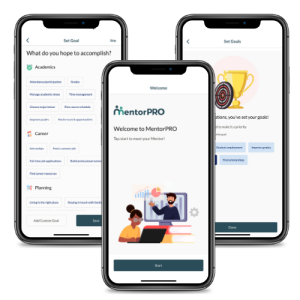
Pro-worker AI offers that infrastructure. We are extending MentorAI to actually serve this way. Tools like this will have an important role to play in improving the skills and effectiveness of mentors. They can review chats or listen to or review a recent mentoring session, flag moments where a mentor navigated a difficult disclosure well or missed a cue, and suggest specific skill-building exercises tailored to the mentor’s developmental stage. They can surface relevant evidence-based strategies in the moment, pulling from the research literature and from anonymized cases across thousands of matches. They can help mentors differentiate between a young person who needs encouragement, one who needs a warm handoff to a clinician, and one who needs a practical problem solved. MentorAI, for example, tracks goals across sessions, and frees the mentor to focus on the relational work that only a human can do.
With well-designed AI supports, trained mentors who are not licensed clinicians could responsibly handle a broader range of youth needs, including early-stage mental health concerns, academic coaching, and college and career planning. Licensed clinicians could focus on the highest-acuity cases. Programs could match intensity of support to intensity of need, which is the core premise of stepped care. And mentors themselves could move along a genuine career ladder, acquiring credentials and earning power rather than cycling in and out of short-term volunteer roles.
Tis future is not guaranteed. MentorAI is competing with companies that have stronger incentives to automate expertise than to extend it. It is easier to build chatbots that replace mentors, and some are already trying. The harder and more valuable work is to build tools that make mentors better, credential them for it, and pay them accordingly.
This is the agenda I believe the mentoring field should adopt. We need to invest in AI tools that coach mentors rather than replace them.
Reference
Acemoglu, D., Autor, D., and Johnson, S. (2026). Building pro-worker artificial intelligence. The Hamilton Project, Brookings Institution. https://www.hamiltonproject.org