Therapeutic Mentoring Certification Course Opens for Fall 2026
For anyone who has spent years working with young people without a bachelor’s degree to show for it, credentialing gaps can feel like the barrier between doing the work and being recognized for it. UMass Boston’s Center for Evidence-Based Mentoring is opening this door through this credentialing opportunity this fall.
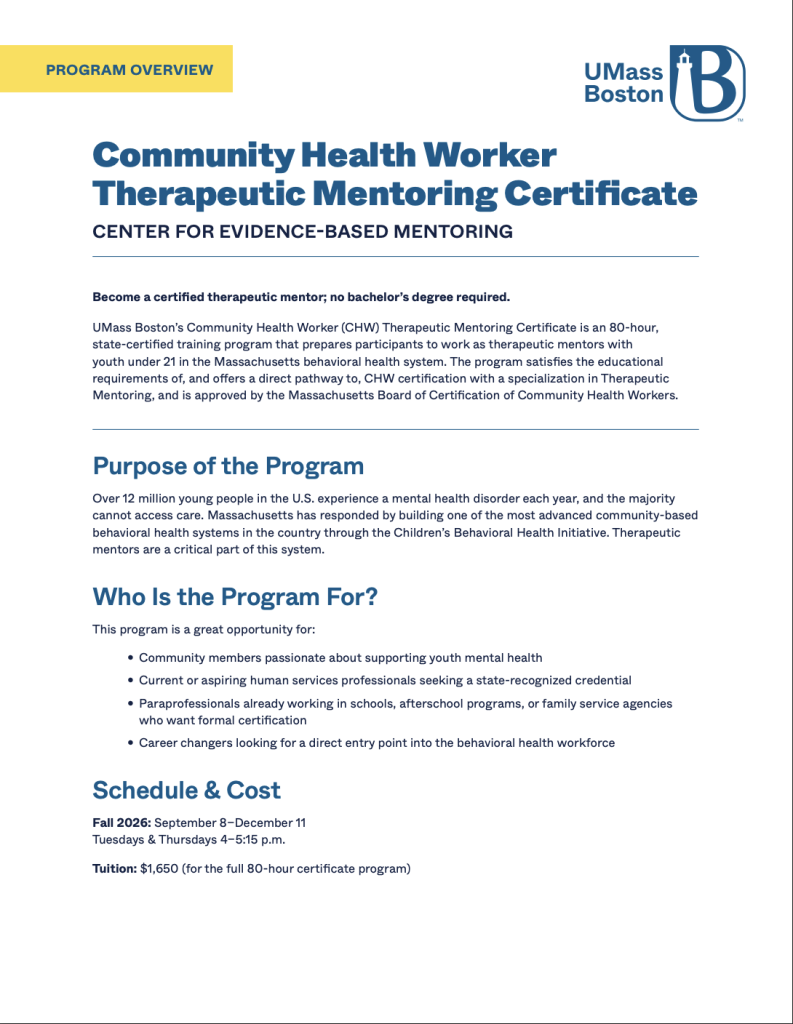
The Community Health Worker (CHW) Therapeutic Mentoring Certificate is an 80-hour, state-certified training that prepares participants to work as therapeutic mentors with youth under 21 in the Massachusetts behavioral health system, no bachelor’s degree required. The program satisfies the educational requirements for CHW certification with a specialization in Therapeutic Mentoring and is approved by the Massachusetts Board of Certification of Community Health Workers.
Why This Role
More than 12 million young people in the U.S. experience a mental health disorder each year, and most never get the care they need. Massachusetts has built one of the country’s most developed community-based behavioral health systems in response, through its Children’s Behavioral Health Initiative, and therapeutic mentors sit at the center of that system. Demand for trained mentors in Boston and across the state is outpacing supply, and the role comes with real earning potential: the average salary for a therapeutic mentor in Boston is $68,000.
Who Should Consider It
The certificate is built for a range of entry points into the field:
- Community members who want to formalize a passion for youth mental health work
- Paraprofessionals already in schools, afterschool programs, or family service agencies looking to make their experience official
- Career changers seeking a direct route into behavioral health
- Aspiring human services professionals who want a state-recognized credential without a four-year degree
Graduates leave positioned for roles as therapeutic mentors, community health workers, family support specialists, or behavioral health paraprofessionals more broadly.
What’s Covered
The 80 hours split into two components. Sixty-four hours cover CHW core competencies, outreach strategies, community assessment, effective communication, cultural responsiveness, care coordination, public health concepts, advocacy, documentation, and professional conduct. The remaining 16 hours are a therapeutic mentoring specialization, covering the field’s history and evidence base, strengths-based approaches to the mentor-mentee relationship, multi-level systems of care, safety planning, working with community agencies, and ethics and professional boundaries.
Logistics
The Fall 2026 cohort runs September 8 through December 11, meeting Tuesdays and Thursdays from 4:00 to 5:15 p.m. Tuition for the full certificate is $1,650.
Learn More
Interested applicants can reach the Center for Evidence-Based Mentoring directly:
Jean Rhodes, Director
jean.rhodes@umb.edu
617.287.7585