The Question Colleges Forget to Ask
Hersch, E., Werntz, A., Deng, Y., Jasman, M., & Rhodes, J. (2026). Can I help with that? The role of goal setting in a technology-enabled peer mentoring program. Journal of Community Psychology, 54, e70115. https://doi.org/10.1002/jcop.70115
Jean Rhodes
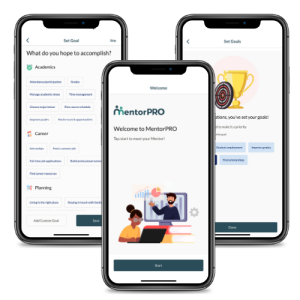
Most colleges ask incoming students for immunization records, housing choices, and a meal-plan preference. Far fewer ask what students hope to accomplish once they arrive. A new study asked that question through MentorPRO, our technology-enabled peer-mentoring platform at a large private university in the northeastern United States. Of 5,782 first-year students who used the platform during the 2022–23 academic year, 3,601 (63%) used its optional goal-setting feature. First-generation students used it more than continuing-generation students, 77.3 percent versus 60.9 percent. Women used it more than men, 66.8 percent versus 55.9 percent. (Hersch et al., 2026)
That is the first practical lesson: students will share their priorities when the question is brief, convenient, and connected to support.
What students said they wanted
Students chose from five domains: academics, career, health and well-being, connections, and finances. They could select several goals and mark priorities.
Joining a club or organization ranked first, ahead of improving grades. Students were not entering college focused only on coursework. They were looking for belonging, structure, relationships, and a path toward work.
Health and well-being goals were also common. Students selected improving well-being 1,807 times, managing stress 1,723 times, and improving health and fitness 1,714 times. These selections identify priorities. They do not diagnose symptoms, measure treatment need, or show that students will follow through without help.
Students selected an average of 10.45 goals and marked 2.73 as priorities. Only five students wrote fully custom goals. (Hersch et al., 2026)
The study does not show that goal setting improved grades, belonging, or persistence. Students chose whether to use the feature, and the analysis cannot fully separate goal setting from motivation, confidence, prior preparation, or general engagement.
But goal setting was significantly associated with end-of-first-semester GPA (B = 0.05, SE = 0.02, 95% CI [0.01–0.09], t = 2.19, p = 0.028).
| Goal | Domain | Students selecting | Share of all selections |
| Join clubs and organizations | Connections | 2,730 | 7.25% |
| Plan course schedule | Academics | 2,347 | 6.23% |
| Build time-management skills | Academics | 2,300 | 6.11% |
| Prepare for relevant work experience | Career | 2,288 | 6.07% |
| Improve grades | Academics | 2,153 | 5.72% |
Recommendations
Ask early
Add a short goal prompt to orientation, mentor matching, advising intake, or the first student-support contact. Keep it optional and easy to revise. The prompt should cover more than academics: belonging, health, work, finances, and daily routines all shape whether students can remain enrolled and engaged.
Turn goals into next actions
A broad goal such as “join a club” needs a next step: identify two organizations, attend one meeting, or ask a mentor for an introduction. “Improve time management” needs a plan for the coming week. Mentors and advisers should help students choose an action that is specific, feasible, and connected to available resources.
Make follow-up part of the service
The goal prompt should trigger a later conversation. A mentor can ask what happened, what got in the way, and whether the goal still fits. The point is not to enforce a promise. It is to help students adjust plans without turning difficulty into a judgment about character.
Monitoring should remain relational. The supportive-accountability model argues that monitoring works best when students experience social presence, clear expectations, trust, benevolence, and a legitimate reason for the check-in. Monitoring without those conditions can feel controlling. (Mohr et al., 2011)
Use the data as a listening tool
Aggregate goal data can show what students are trying to navigate. If thousands select joining a club, institutions should examine whether students can find welcoming, affordable, accessible opportunities. If first-generation students select health and well-being goals at higher rates, programs should ask what forms of support students want and whether current services are easy to reach.
The bottom line
Goals are useful because they make student priorities visible. They become an intervention only when a support program helps students translate those priorities into realistic action and returns to the conversation later.
The most valuable question may be simple: What do you hope to accomplish, and what would help you take the next step?
References
Clark, D., Gill, D., Prowse, V., & Rush, M. (2020). Using Goals to Motivate College Students: Theory and Evidence From Field Experiments. In Review of Economics and Statistics (Vol. 102, pp. 648–663). https://doi.org/10.1162/rest_a_00864
Dam, A., Gray-Lobe, G., Kremer, M., Laat, J. de, & Morsink, K. (2025). Learning to Work Towards Goals: A Sequential Evaluation of the Effect of a Goal-Setting Course on Academic and Soft Skills. SSRN Electronic Journal. https://doi.org/10.3386/w34562
Dekker, I., Schippers, M., & Schooten, E. van. (2021). Reflective Goal-setting Improves Academic Performance in Teacher and Business Education: A Large-scale Field Experiment. Journal of Research on Educational Effectiveness, 17, 561–589. https://doi.org/10.1080/19345747.2023.2231440
Fazel, P., Kovács, K. E., & Kovács, J. (2025). Coaching in higher education: a systematic review of coaching intervention on university students. Coaching: An International Journal of Theory, Research and Practice, 19, 173–202. https://doi.org/10.1080/17521882.2025.2601539
Gehreke, L., Hirschberger, S., & Kauffeld, S. (2026). Navigating new horizons: the efficacy of study-embedded group-coaching in facilitating academic transitions. Frontiers in Education. https://doi.org/10.3389/feduc.2026.1798355
Heintalu, K., Saks, K., Edisherashvili, N., & Dekker, I. (2025). The conceptualisation of goal setting and goal orientation in higher education: A systematic literature review. Educational Research Review. https://doi.org/10.1016/j.edurev.2025.100709
Hersch, E., Werntz, A., Deng, Y., Jasman, M., & Rhodes, J. E. (2026). Can I Help With That? The Role of Goal Setting in a Technology‐Enabled Peer Mentoring Program. Journal of Community Psychology, 54. https://doi.org/10.1002/jcop.70115
Jaarsveld, G. M. V., Wong, J., Baars, M., Specht, M., & Paas, F. (2025). Enhancing goal attainment in higher education with a scripted conversational agent: Effects of monitoring and reflection support in digital learning. Comput. Educ., 239, 105441. https://doi.org/10.1016/j.compedu.2025.105441
Jaarsveld, G. M. van, Wong, J., Baars, M., Specht, M., & Paas, F. (2025). Scaling goal-setting interventions in higher education using a conversational agent: Examining the effectiveness of guidance and adaptive feedback. Proceedings of the 15th International Learning Analytics and Knowledge Conference. https://doi.org/10.1145/3706468.3706510
Mohr, D., Cuijpers, P., & Lehman, K. (2011). Supportive Accountability: A Model for Providing Human Support to Enhance Adherence to eHealth Interventions. Journal of Medical Internet Research, 13. https://doi.org/10.2196/jmir.1602
Schippers, M. C., Scheepers, A. W. A., & Peterson, J. B. (2015). A scalable goal-setting intervention closes both the gender and ethnic minority achievement gap. In Palgrave Communications (Vol. 1). https://doi.org/10.1057/palcomms.2015.14
Su, Y. (2026). Hitting the mark: the power of self-chosen goals in academic success. Review of Behavioral Economics. https://doi.org/10.1108/rbe-01-2025-0254
Wright, D. S., Kanaparthy, N., Melnick, E., Levy, D. R., Huot, S., Hsiao, A. L., Schwamm, L. H., & Ong, S. Y. (2025). The Effect of Ambient Artificial Intelligence Scribes on Trainee Documentation Burden. Applied Clinical Informatics, 16, 872–878. https://doi.org/10.1055/a-2647-1142